
One of the most common questions is whether the changes in air pressure during takeoff, cruising altitude, and landing could affect a pacemaker device.
The good news is that normal cabin pressure on commercial airlines is not known to damage, interfere with, or reprogram a modern pacemaker. Today’s pacemakers are designed to operate reliably in a wide range of everyday environments, including commercial air travel.
That doesn’t mean every person with a pacemaker is automatically fit to fly, however. The more important question is usually whether your underlying heart condition, recent surgery, or other medical issues make flying appropriate.
This guide explains how aircraft cabin pressure works, why it generally does not affect your pacemaker, and when you should speak with your cardiologist before your trip.
Quick Answer
No. Cabin pressure on commercial flights does not normally affect a pacemaker.
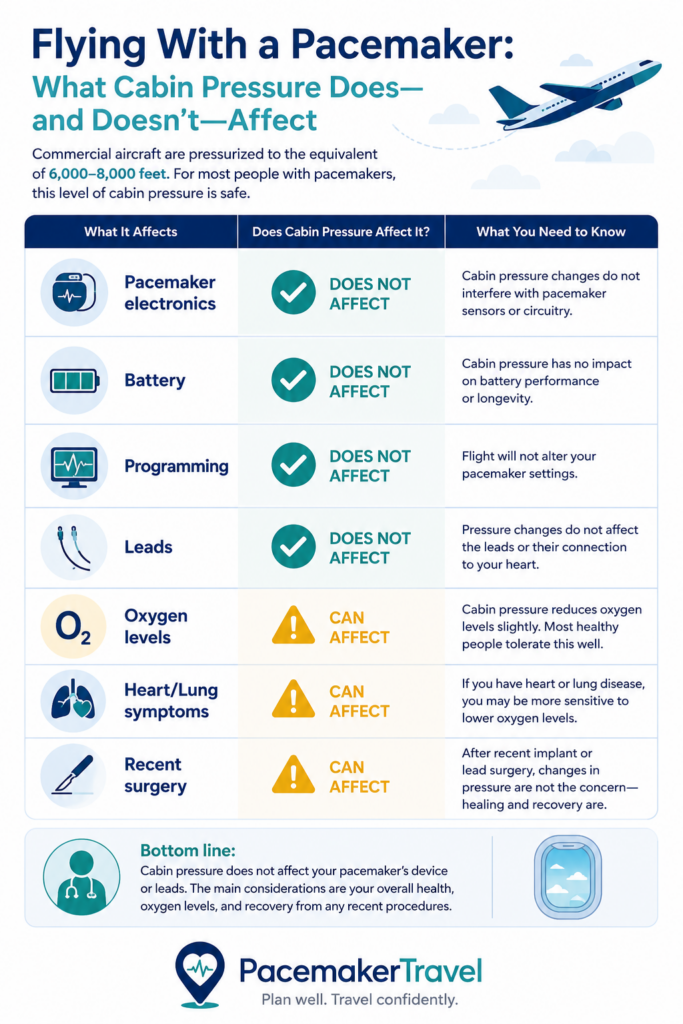
Modern pacemakers are designed to function normally inside pressurized aircraft cabins. Commercial airplanes maintain cabin pressure roughly equivalent to 6,000–8,000 feet (1,830–2,440 m) above sea level, and there is no evidence that these pressure changes damage the pacemaker, alter its programming, shorten battery life, or interfere with pacing.
The bigger consideration is your overall medical condition. Some people with significant heart failure, lung disease, recent pacemaker implantation, or unstable symptoms may need medical clearance before flying.
How Aircraft Cabin Pressure Actually Works
Many travelers imagine that the cabin is pressurized to sea level throughout the flight. In reality, commercial aircraft fly at cruising altitudes of around 30,000 to 40,000 feet, where the outside air is far too thin to breathe safely.
Instead, the cabin is pressurized to a much lower altitude—typically between 6,000 and 8,000 feet. Newer aircraft such as the Boeing 787 Dreamliner and Airbus A350 often maintain even lower cabin altitudes to improve passenger comfort.
The amount of oxygen in the air remains approximately 21%, just as it does at sea level. What changes is the air pressure, meaning each breath contains fewer oxygen molecules than it would at ground level.
For most healthy people—and for many people with stable heart disease—this reduction causes little or no difficulty. Others may notice mild fatigue or shortness of breath, particularly if they already have significant heart or lung disease.
Does Lower Cabin Pressure Affect the Pacemaker Itself?
The simple answer is no.
Modern pacemakers are sealed medical devices housed in durable titanium cases and engineered to withstand a wide range of environmental conditions encountered during everyday life and travel.
Current evidence indicates that the cabin pressure found on commercial aircraft does not:
- change pacemaker programming
- interfere with electrical pacing
- affect sensing of your heart rhythm
- shorten battery life
- damage the device
- loosen or move implanted leads
Thousands of people with pacemakers fly safely every day, and commercial aviation has decades of experience transporting passengers with implanted cardiac devices.
Why Doesn’t Pressure Affect the Device?
Unlike some mechanical devices that depend on air pressure, a pacemaker operates entirely using internal electronic circuitry powered by a sealed battery.
The electronics are isolated from changes in atmospheric pressure, and the pressure changes experienced during commercial flights are well within the operating range for modern devices.
Simply put:
Your pacemaker doesn’t “know” whether you’re sitting at sea level or flying in a pressurized aircraft cabin.
What Cabin Pressure Can Affect
Although the pacemaker itself is not affected, the person wearing it may be.
Because cabin pressure is lower than at sea level, your blood carries slightly less oxygen during flight.
For most travelers this isn’t a problem.
However, reduced oxygen levels may worsen symptoms in people with:
- advanced heart failure
- significant lung disease
- severe anemia
- pulmonary hypertension
- unstable angina
- recent heart attack
- severe valve disease
In these situations, your cardiologist may recommend additional evaluation before travel or discuss whether supplemental oxygen is appropriate.
Does Being Pacemaker-Dependent Change the Answer?
Many readers worry because they are pacemaker-dependent, meaning their heart relies heavily—or entirely—on the pacemaker to maintain an adequate heart rate.
Fortunately, commercial cabin pressure does not change this answer.
A properly functioning pacemaker continues to monitor your heart rhythm and deliver pacing as programmed throughout the flight.
Being pacemaker-dependent does not automatically make flying unsafe.
However, people who depend on their pacemaker often have more complex underlying heart conditions. Your healthcare team may therefore consider factors such as:
- your heart function
- recent symptoms
- recent device checks
- other medical conditions
- whether you’ve recently had surgery
The concern is usually your overall cardiovascular stability, not the aircraft environment itself.
Why Doctors Sometimes Recommend Waiting Before Flying
Some people assume they’re told to delay flying because of cabin pressure.
That’s usually not the reason.
The waiting period after implantation is intended to allow time for:
- the incision to heal
- the leads to become securely attached inside the heart
- swelling to improve
- early complications to become apparent
- your first follow-up appointment
The exact timing depends on your individual recovery and should always follow the advice of your implanting cardiologist or pacemaker clinic.
Commercial Airliners vs. High-Altitude Destinations
People sometimes confuse air travel with high-altitude travel.
They’re related—but they’re not the same.
Commercial Airliners
Aircraft cabins are pressurized.
Even though the plane may be flying above 35,000 feet, passengers experience conditions similar to approximately 6,000–8,000 feet.
Mountain Destinations
Once you arrive in places such as:
- Aspen
- Colorado ski resorts
- Cusco, Peru
- La Paz, Bolivia
you may remain at high altitude continuously.
That prolonged exposure may affect some people with significant heart or lung disease far more than the flight itself.
Small Private Aircraft
Some smaller aircraft are not pressurized.
If you’re planning to fly in an unpressurized aircraft, discuss your plans with your cardiologist beforehand, particularly if you’ll be flying at higher altitudes.
When Should You Talk to Your Cardiologist Before Flying?
Although most people with a stable pacemaker can fly safely after medical clearance, you should speak with your healthcare team before traveling if any of the following apply.
| Situation | Discuss Before Flying? |
|---|---|
| Recent pacemaker implantation | Yes |
| New chest pain | Yes |
| Recent fainting | Yes |
| Increasing shortness of breath | Yes |
| Heart failure | Yes |
| Lung disease requiring oxygen | Yes |
| Recent hospitalization | Yes |
| Planned travel in an unpressurized aircraft | Yes |
| Stable pacemaker with no new symptoms | Usually routine advice is sufficient |
Practical Tips Before Your Flight
Before traveling:
- Carry your pacemaker identification card.
- Keep medications in your carry-on baggage.
- Stay hydrated during longer flights.
- Walk periodically during long-haul flights if medically appropriate.
- Know how to contact your cardiologist or pacemaker clinic.
- Make sure your travel insurance covers your medical conditions.
Most importantly, don’t let unnecessary worries about cabin pressure stop you from traveling if your healthcare team has cleared you to fly.
Frequently Asked Questions
Can airplane pressure damage a pacemaker?
No. There is no evidence that normal cabin pressure on commercial airlines damages modern pacemakers.
Can flying change my pacemaker settings?
No. Commercial flights do not normally alter pacemaker programming or settings.
Does cabin pressure shorten battery life?
No. Normal aircraft cabin pressure does not affect pacemaker battery performance.
Can I fly if I’m completely dependent on my pacemaker?
Many pacemaker-dependent people travel safely. Your ability to fly depends primarily on your overall heart condition and your cardiologist’s assessment—not on cabin pressure itself.
What if I need oxygen when I fly?
If your healthcare provider believes you’ll need supplemental oxygen, contact your airline well before departure. Airlines have specific procedures and advance notice requirements for in-flight oxygen arrangements.
Is flying in a small private aircraft different?
It can be. Some private aircraft are not pressurized, meaning you’ll be exposed to higher altitudes than on commercial flights. Speak with your cardiologist if you expect to fly in an unpressurized aircraft.
Conclusion
For most travelers, cabin pressure is not something to fear after receiving a pacemaker.
Modern pacemakers are designed to function normally in the pressurized environment of commercial aircraft, and there is no evidence that flying changes how the device works.
Instead, the most important question is whether you are medically ready to travel. Your recovery after implantation, your underlying heart condition, and any other health issues matter far more than the cabin pressure itself.
If you’ve recently had your pacemaker implanted, developed new symptoms, or have significant heart or lung disease, check with your cardiologist before your trip. Otherwise, once you’ve been medically cleared, you can usually focus on enjoying your journey rather than worrying about your pacemaker.
Medical Disclaimer
This article is intended for general educational purposes only and should not replace personalized medical advice. Whether it is appropriate for you to fly depends on your medical history, the reason you have a pacemaker, your recovery after implantation, and your overall health. Always follow the advice of your cardiologist, electrophysiologist, pacemaker clinic, or other qualified healthcare professional.
Sources
- American Heart Association. Living With Your Pacemaker.
- Centers for Disease Control and Prevention. CDC Yellow Book: Air Travel.
- Federal Aviation Administration. Aeronautical Information Manual – Effects of Altitude.
- Medtronic. Living With Your Pacemaker.
- Abbott. Pacemaker Patient Information.
- Boston Scientific. Living With Your Pacemaker.
- BIOTRONIK. Patient Travel Guidance.