
For most people with a properly functioning pacemaker, the answer is yes: commercial air travel is generally considered reasonable once you are medically stable.
The pacemaker itself is rarely the main obstacle. Normal cabin pressure, aircraft electronics and modern airport body scanners are not expected to stop or reprogram a contemporary pacemaker. The questions that matter more are how recently the device was implanted, whether the incision and leads are healing normally, whether you have any new symptoms, and whether another heart or lung condition affects your fitness to fly.
A short domestic flight taken by someone with a long-established, routinely checked pacemaker is very different from a long-haul journey taken a few days after an emergency implantation. This guide explains how to assess those differences, prepare for airport security and plan for the flight and destination.
Can you fly with a pacemaker?
Most people with a properly functioning pacemaker can fly once they are medically stable. The pacemaker itself is not usually affected by cabin pressure or normal aircraft electronics. Recent implantation, an unhealed incision, new symptoms, a device concern or an unstable heart or lung condition may mean that the trip should first be reviewed with your pacemaker clinic.
Most Stable Pacemaker Patients Can Fly
Having a pacemaker does not ordinarily prevent someone from travelling as an airline passenger. The UK Civil Aviation Authority states that people with pacemakers may travel by air once medically stable and that interaction with aircraft electronics or aviation-security devices is highly unlikely for commonly used modern device configurations.
Flying is often relatively straightforward when:
- the pacemaker has been in place long enough for the procedure to heal;
- routine device checks are up to date;
- there are no known battery, lead or programming concerns;
- there are no new or worsening symptoms;
- the underlying heart condition is stable;
- the traveller can manage the physical demands of the airport and journey.
The presence of a pacemaker is only one part of the decision. A device check can confirm that the pacemaker and its leads appear to be functioning properly, but it cannot by itself establish that every medical condition affecting the traveller is stable.
[table id=2 /]This is a planning guide rather than a medical-clearance test. Individual advice may differ based on the reason for the pacemaker, the procedure performed and the person’s other medical conditions.
Why Flying Usually Does Not Interfere with a Pacemaker
The two most common device-related concerns are cabin pressure and electronic interference. Neither is normally considered a reason for a medically stable pacemaker patient to avoid flying.
Cabin pressure does not normally stop a pacemaker
Commercial aircraft cabins are pressurized, although the pressure is lower than it is at sea level. This produces a modest reduction in the amount of oxygen available to the body. Most passengers tolerate that change without difficulty.
The pressure change is not expected to stop, damage or reprogram a functioning pacemaker. However, reduced oxygen availability may be relevant when the traveller has another condition, such as:
- unstable or advanced heart failure;
- significant lung disease;
- pulmonary hypertension;
- low blood-oxygen levels;
- severe anemia;
- another illness affecting oxygen delivery.
In these situations, the concern is usually the person’s underlying health rather than the pacemaker hardware.
Someone who becomes breathless during gentle activity, has previously required oxygen or has been told that oxygen levels are low should discuss the flight with a clinician. Supplemental oxygen generally needs to be arranged with the airline in advance, and airline policies vary.
Does Cabin Pressure Affect a Pacemaker?
Normal aircraft electronics are unlikely to cause interference
Contemporary pacemakers are designed to tolerate the electromagnetic environments encountered during normal daily activities. The UK Civil Aviation Authority describes significant interaction with aircraft electronics as highly unlikely for common modern pacemaker configurations.
This does not mean that every powerful electromagnetic source is harmless at any distance. It means that the ordinary electronic systems encountered by an airline passenger are not generally considered a reason to avoid flying.
The Pacemaker Is Only One Part of the Fitness-to-Fly Decision
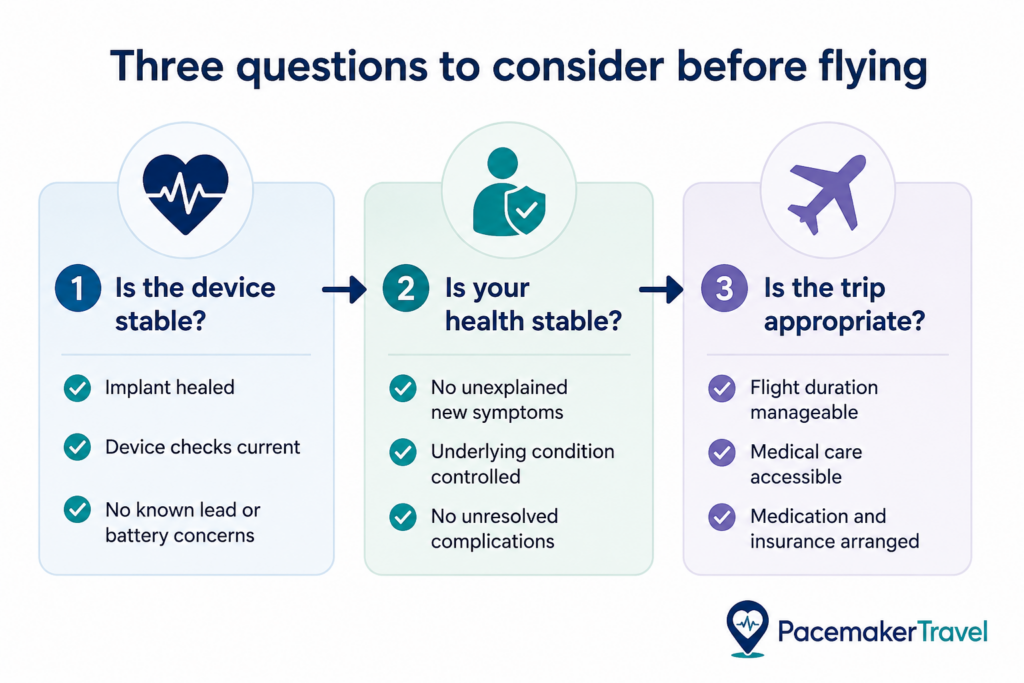
A useful way to assess a trip is to separate the decision into three questions.
Is the pacemaker and implant site stable?
Consider:
- how recently the pacemaker was implanted;
- whether new leads were inserted or an existing lead was revised;
- whether the incision has healed;
- whether there was bleeding, infection or a collapsed lung after the procedure;
- whether the device has generated an alert;
- whether the clinic has identified a battery or lead concern;
- whether the first follow-up appointment has taken place.
Is your current health stable?
The condition that led to the pacemaker may be more important to flying than the device itself.
A person may have a normally functioning pacemaker but still need assessment because of:
- new fainting or near-fainting;
- worsening heart failure;
- uncontrolled rhythm problems;
- chest pain;
- increasing shortness of breath;
- a recent heart attack or cardiac procedure;
- a recent hospitalization;
- significant lung disease or oxygen requirements.
“Medically stable” is not a single diagnosis or test result. In practical terms, it usually means that there is no unresolved complication, unexplained deterioration or active symptom requiring assessment before travel.
It is also important not to confuse medical stability with an insurer’s definition of stability. An insurer may apply a specific period during which there must have been no medication changes, new symptoms, tests or treatment, even when a doctor considers the person fit to fly.
Is the trip suitable for your current condition?
A direct one-hour flight to a major city involves fewer practical consequences than a 14-hour flight followed by several hours of travel to a remote destination.
Consider:
- total flight and connection time;
- distance through the airports;
- availability of mobility assistance;
- access to medication during delays;
- destination altitude;
- access to emergency and cardiac care;
- whether medical evacuation might be needed;
- planned physical activities;
- travel-insurance coverage.
The pacemaker may be functioning perfectly, but the trip can still require additional planning because of mobility, other medical conditions or limited access to care.
How Soon Can You Fly After Pacemaker Implantation?
There is no universal waiting period that applies to everyone after pacemaker surgery.
Published hospital instructions differ. Imperial College Healthcare NHS Trust says that travel may be possible one week after an uncomplicated procedure, Leeds Teaching Hospitals advises that flying is safe after two weeks, while Cambridge University Hospitals advises waiting until the first device check at approximately four to six weeks.
These different recommendations do not necessarily conflict. “Pacemaker implantation” can describe several different clinical situations, and hospitals may use different follow-up protocols.
The appropriate timing may depend on:
[table id=1 /]Follow the discharge instructions provided by the hospital that performed the procedure. When asking about a trip, give the clinic specific information:
- the planned departure date;
- flight duration;
- number of connections;
- destination;
- length of stay;
- access to medical care;
- proposed activities.
A generic online waiting period should not be the sole basis for booking a non-refundable trip.
[Internal link: Flying After Pacemaker Surgery: How Long Should You Wait?]
When to Ask Your Cardiologist or Pacemaker Clinic Before Flying
Someone with a long-established pacemaker and no change in health may not need a special appointment before every ordinary flight.
Contact your cardiologist, electrophysiologist or pacemaker clinic before flying when:
- the pacemaker, generator or leads were implanted or revised recently;
- the incision is not fully healed;
- you have fainted or nearly fainted;
- you have new dizziness, chest pain, breathlessness or persistent palpitations;
- your device has generated an alert;
- you have been told about a battery, lead or programming concern;
- you recently visited an emergency department or were hospitalized;
- medication was recently changed because of symptoms;
- you may require supplemental oxygen;
- a scheduled pacemaker check will fall due while you are away;
- the destination is remote or has limited medical care;
- you are uncertain whether your current symptoms are stable.
Before a prolonged or remote trip, a recent device check may be particularly helpful when the traveller is pacemaker-dependent, the battery is nearing replacement or there has been a previous device issue.
Warning Signs That Should Be Assessed Before Flying
Do not rely on general travel guidance if you have new or worsening symptoms.
Seek medical assessment before travelling if you experience:
- fainting or near-fainting;
- new chest pain;
- new or worsening shortness of breath;
- severe or unexplained dizziness;
- sustained or concerning palpitations;
- marked new weakness;
- a pacemaker alert or a request from the clinic for review;
- increasing redness, pain, swelling or drainage around a recent incision;
- fever after a recent implantation procedure;
- new swelling of the arm on the pacemaker side;
- sudden one-sided leg swelling, especially with chest pain or breathlessness.
These symptoms are not necessarily caused by the pacemaker, but they may indicate a problem requiring assessment before a flight. Severe chest pain, fainting, major breathing difficulty or other acute symptoms require urgent or emergency care.
[Internal link: Pacemaker Symptoms That Need Medical Attention]
Does Pacemaker Dependence Change Whether You Can Fly?
Pacemaker dependence does not automatically make commercial air travel unsafe.
The term generally means that the person’s own rhythm may not provide an adequate heartbeat without pacing. It describes the potential consequences of losing effective pacing; it does not mean that the device is more likely to be disrupted by an aircraft.
Additional planning may nevertheless be sensible because a device problem could have more serious consequences for someone who depends on it. Before a long or remote trip, the pacemaker clinic may review:
- when the device was last checked;
- remaining battery life;
- lead measurements and stability;
- recorded alerts;
- the destination’s access to compatible device services;
- the length and remoteness of the trip.
A medically stable pacemaker-dependent traveller with a recently checked device may be better prepared to fly than a non-dependent patient with unexplained fainting or an unresolved heart-rhythm problem.
[Internal link: Flying When You Are Pacemaker-Dependent]
What to Arrange Before Booking the Flight
Planning before making non-refundable payments is especially important after a recent procedure or change in health.
Confirm the medical timing
Ask the pacemaker clinic whether:
- your departure date allows enough recovery time;
- a device check should occur before you leave;
- current symptoms require assessment;
- arm or lifting restrictions will still apply;
- the destination or flight length changes its advice.
Consider the physical demands of the airport
Being medically stable does not necessarily mean that walking through a large terminal, standing in several lines and managing luggage will be easy.
Airport assistance may help when you have:
- limited walking tolerance;
- short connection times;
- difficulty standing for long periods;
- restrictions on lifting after a recent implant;
- another condition affecting mobility or balance.
Request assistance through the airline in advance where possible.
Review destination medical access
For a routine visit to a major city, detailed contingency planning may not be necessary. It becomes more useful for remote travel, cruises, expeditions or prolonged stays.
Consider:
- the nearest appropriate hospital;
- how long it would take to reach care;
- whether a local facility can access support for your device manufacturer;
- whether emergency evacuation is covered;
- how to reach your insurer’s assistance service.
Check travel insurance before paying
Medical clearance to fly does not guarantee that an insurance policy will cover a pacemaker-related claim.
Insurers may ask about:
- the pacemaker;
- the underlying heart-rhythm condition;
- the implantation date;
- recent hospital treatment;
- medication changes;
- specialist appointments;
- pending tests or procedures;
- new symptoms.
Check the exact wording of the medical questionnaire and policy. Do not assume that mentioning only the pacemaker fully answers a question about the underlying condition or recent treatment.
Check how your pacemaker may affect travel insurance
Recent implantation, medication changes and pending tests can influence eligibility even when you feel well enough to travel. Review the medical questions and stability requirements before making non-refundable bookings.
[Internal link: Travel Insurance for People with Pacemakers]
What to Pack in Your Carry-On
Keep essential medication and medical information accessible rather than placing them only in checked luggage.
Bring:
- your pacemaker identification card;
- a current list of medication, including generic names and doses;
- enough medication for the trip and reasonable delays;
- clearly labelled medication containers where practical;
- pacemaker clinic contact information;
- the manufacturer and model of your device;
- travel-insurance policy and emergency-assistance details;
- a brief medical summary if your history is complex;
- a medical letter when needed for oxygen, equipment or particular medications;
- remote-monitoring equipment when your clinic recommends bringing it.
The CDC advises travellers with chronic conditions to continue taking prescribed medication and prepare for their health needs throughout the journey. It also notes that individual countries may restrict medicines that are routinely available elsewhere.
Medtronic advises patients to carry their device identification card while travelling because it can help both airport-security staff and healthcare professionals.
Do you need a doctor’s letter?
A pacemaker alone does not normally mean that every passenger requires a doctor’s letter.
A letter may be useful when:
- the pacemaker was implanted recently;
- you have several medical conditions;
- you need oxygen or other medical equipment;
- you carry injectable, liquid or controlled medication;
- the airline requests medical clearance;
- you will be travelling somewhere remote.
The pacemaker ID card is usually the most important device-specific document. It identifies the device but does not exempt you from airport screening.
[Internal link: Pacemaker ID Cards and Medical Letters for Travel]
Going Through Airport Security with a Pacemaker
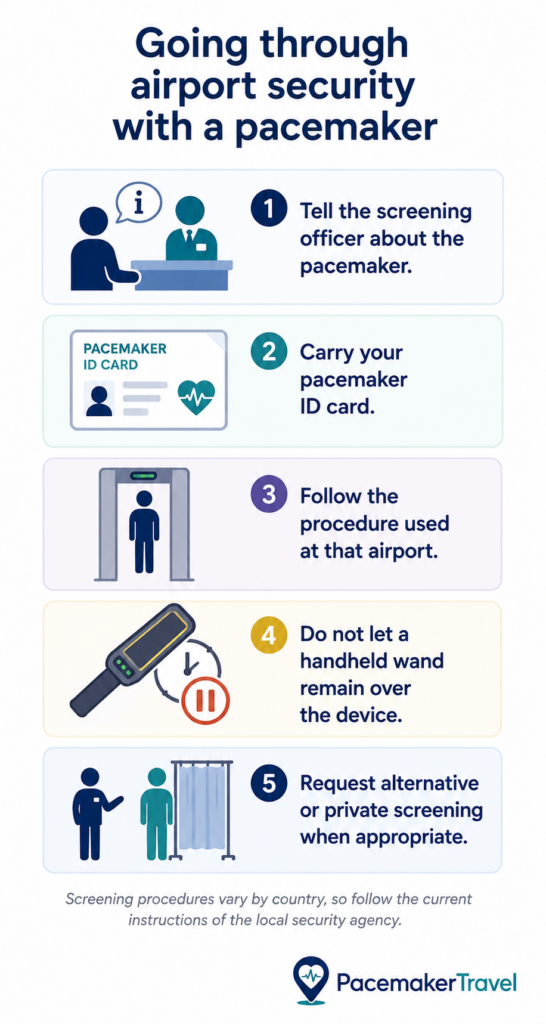
Airport screening rules vary, so follow the instructions of the security agency in the country where you are being screened.
A practical approach is to:
- Tell the screening officer that you have a pacemaker before screening begins.
- Carry your pacemaker ID card and show it when requested.
- Follow the local agency’s procedure.
- Do not allow a handheld wand to be held or repeatedly moved over the pacemaker.
- Ask about alternative or private screening when needed.
Full-body scanners
Modern millimetre-wave body scanners are generally considered safe for pacemaker users. CATSA states that its full-body scanner uses low-level radio-frequency energy and is safe for passengers with pacemakers. Medtronic and Boston Scientific also state that modern full-body scanners should not harm or alter their pacemakers when used as intended.
Walk-through metal detectors
Device manufacturers generally advise that walking normally through a metal-detector archway is unlikely to affect a pacemaker. They recommend walking through at a normal pace without stopping, touching or leaning against the equipment.
However, the screening agency may instruct pacemaker users not to use the walk-through detector.
In Canada, CATSA currently states that passengers with pacemakers or defibrillators should not be screened using walk-through or handheld metal detectors. It directs travellers to tell the officer where the device is located and offers other screening methods.
In the United States, TSA similarly states that a person with an internal medical device such as a pacemaker should not be screened using a walk-through metal detector.
This is not necessarily a scientific disagreement. A manufacturer explains the technical likelihood of device interference, while a government agency establishes the screening procedure passengers should follow.
The process may therefore differ on the outbound and return journeys.
Handheld screening wands
A handheld wand can potentially cause temporary interference if it is held over the pacemaker for too long. Boston Scientific advises that, if a wand must be used, the officer should perform the search quickly and not hold the wand over the pacemaker. Medtronic gives similar advice against holding or repeatedly moving a wand over the device.
Where available, a physical search can be used instead. You may also be able to request that the search take place in a private area.
Airport-security checklist
- Tell the officer about the pacemaker before screening.
- Carry the device ID card.
- Follow the current procedure in that country.
- Do not let a handheld wand remain over the device.
- Request alternative or private screening when appropriate.
[Internal link: Airport Security with a Pacemaker]
During the Flight
Once on board, most people with an established pacemaker do not need to take special action for the device itself.
Practical steps include:
- keeping medication accessible;
- taking medication according to the intended schedule;
- following any prescribed fluid restriction;
- moving your legs and changing position during longer journeys;
- asking for help with overhead luggage if the implant is recent;
- telling the cabin crew if concerning symptoms develop.
Generic advice to drink large amounts of water is not appropriate for everyone. If you have heart failure, kidney disease or a prescribed fluid restriction, continue to follow your clinician’s instructions.
A pacemaker is also not, by itself, a reason to take aspirin, change an anticoagulant dose or buy compression stockings for a flight.
Are Long-Haul Flights Different?
Longer flights do not ordinarily create greater electromagnetic risk to the pacemaker. They do increase the time spent sitting and the period during which access to full medical care may be limited.
The CDC states that travel lasting more than four hours can increase the risk of blood clots, although the risk for most travellers remains small. Additional risk factors include recent surgery or hospitalization, a previous clot, cancer, limited mobility and several other health conditions.
For a longer journey:
- move your legs regularly;
- walk when it is safe and physically appropriate;
- keep medication and medical records accessible;
- plan medication timing across time zones;
- arrange assistance for long connections if needed;
- ask your clinician about clot prevention when you have additional risk factors.
The CDC advises against taking aspirin solely to prevent travel-related blood clots. Compression stockings or preventive medication may be appropriate for some higher-risk travellers, but these should be discussed with a clinician rather than used automatically because of a pacemaker.
[Internal link: Long-Haul Flights with a Pacemaker]
International and Remote Travel
A pacemaker does not restrict you to destinations close to home. The farther you travel from your usual clinic, however, the more important it becomes to carry clear medical information and understand where help is available.
For international or remote travel, keep accessible:
- your pacemaker ID card;
- device manufacturer and model;
- date and location of implantation;
- current medication list;
- pacemaker clinic contact information;
- insurer assistance details;
- a short medical summary when appropriate.
Not every hospital can immediately interrogate every pacemaker model. For a prolonged or remote trip, it may be sensible to identify a hospital with cardiac services or ask the device manufacturer about support in the destination.
Should you bring your remote monitor?
Not every traveller needs to carry a home pacemaker monitor.
The answer may depend on:
- how long you will be away;
- the monitoring system used;
- whether scheduled transmissions are due;
- whether there have been previous alerts;
- cellular or internet compatibility;
- how your clinic handles transmissions received from abroad.
Remote monitoring is not the same as continuous emergency observation. Do not wait for a remote-monitoring response if you develop urgent symptoms.
Ask your pacemaker clinic whether bringing the monitor would add useful protection for your particular trip.
[Internal link: Should You Bring Your Pacemaker Monitor on Vacation?]
Travel Insurance When You Have a Pacemaker
Travel insurance is a separate question from medical fitness to fly.
A clinician may consider you well enough to travel while an insurer applies an exclusion or declines coverage because of a recent procedure, medication change, pending investigation or other policy condition.
Answer every medical question accurately. Depending on the insurer and jurisdiction, you may need to disclose:
- the pacemaker;
- the condition that led to implantation;
- the procedure date;
- hospital admissions;
- recent or ongoing symptoms;
- medication changes;
- specialist consultations;
- tests that are pending or scheduled;
- previous complications.
Before buying a policy, ask:
- Is the pacemaker and underlying diagnosis covered?
- What stability period applies?
- Does a recent implantation or generator replacement affect eligibility?
- Do pending tests or routine follow-up appointments matter?
- Are recent medication changes relevant?
- Is emergency medical evacuation included?
- Is cancellation covered if a doctor advises against travel?
- Will the answers and coverage be confirmed in writing?
A comparison service or broker can help identify possible policies, but it may not represent every insurer and cannot guarantee eligibility or claims approval. The medical questionnaire, recorded answers, exclusions and final policy wording determine coverage.
Understand the medical questions before comparing policies
Look for coverage that addresses both the pacemaker and the condition that led to it. Confirm recent procedures, medication changes and pending tests directly with the insurer or licensed broker.
Button: Compare travel insurance options
[Internal link: Travel Insurance for People with Pacemakers]
Pre-Flight Checklist for Pacemaker Travellers
Medical readiness
- I have no unexplained new or worsening symptoms.
- My incision has healed, or my implanting team has approved the timing.
- Any required pacemaker follow-up has been completed.
- I have checked whether an appointment is due during the trip.
- Oxygen or other medical support has been arranged if needed.
Documents and medication
- Pacemaker ID card
- Medication list with generic names and doses
- Enough medication for the trip and possible delays
- Pacemaker-clinic contact details
- Device manufacturer and model information
- Insurance policy and assistance number
- Medical summary or letter where useful
Airport and flight
- I have reviewed the security procedure at my departure airport.
- I will tell the officer about the pacemaker.
- Mobility assistance has been requested if needed.
- Essential medication is in my carry-on.
- I have planned medication timing for a long-haul journey.
Destination and emergencies
- I know how to contact local emergency services.
- I have considered access to appropriate care.
- My travelling companion knows where my medical information is stored.
- My insurer’s assistance number is available offline.
- I know whether my pacemaker monitor should travel with me.
Frequently Asked Questions
Can cabin pressure stop a pacemaker from working?
Normal commercial-aircraft cabin pressure is not expected to stop or reprogram a properly functioning pacemaker. Reduced oxygen pressure may be more relevant to someone with significant heart or lung disease than to the device itself.
Do I need a doctor’s letter to fly with a pacemaker?
Usually not for the pacemaker alone. A letter may be useful when you need airline medical clearance, oxygen, special equipment or documentation for particular medication. Carry your pacemaker identification card.
Will my pacemaker set off an airport metal detector?
It may. The metal in the device can trigger an alarm, but an alarm does not mean that the pacemaker has malfunctioned. Tell the screening officer about the device and follow the agency’s procedure.
Can I request a physical search instead of electronic screening?
Alternative and private screening options vary by country. In Canada, passengers with implanted medical devices can receive alternative screening and can request privacy when a physical search is needed. TSA also uses alternative procedures for passengers with internal medical devices.
Can I fly if I am pacemaker-dependent?
Pacemaker dependence does not automatically prevent flying. A recent device check, adequate battery life, stable leads and appropriate destination planning may be especially important before a long or remote trip.
Should I bring my home pacemaker monitor?
Not necessarily. Ask your clinic, particularly for an extended trip. The answer depends on the system, trip length, connectivity, scheduled transmissions and your clinic’s monitoring practices.
Do I need to tell the airline that I have a pacemaker?
A stable pacemaker by itself does not usually require advance notification. Contact the airline if you need supplemental oxygen, mobility assistance, medical equipment or formal fitness-to-fly clearance.
Can I fly when my pacemaker battery is getting low?
Pacemaker monitoring normally identifies battery depletion before the device stops functioning. If your clinic has recommended replacement, issued an alert or shortened the follow-up interval, ask whether the trip should occur before or after the procedure.
Can I fly with a leadless pacemaker?
In general, a leadless pacemaker does not prevent air travel once you have recovered and are medically stable. Recovery considerations differ because there is no chest pocket or transvenous lead, but the vascular access site, underlying condition and procedure timing still matter.
The Bottom Line
For many people, a pacemaker changes how a flight should be prepared for, but it does not prevent the flight itself.
A traveller with a healed implant, no new symptoms and a normally functioning device can generally use commercial air travel. The situations requiring more individual advice include recent implantation, unresolved complications, device or lead concerns, worsening heart or lung disease, and trips where appropriate medical care would be difficult to reach.
Before departure:
- confirm that you are medically stable;
- carry your pacemaker ID card and essential medication;
- review the airport-security procedure for each country;
- arrange mobility or oxygen assistance when needed;
- disclose the requested medical history to the insurer;
- ask your clinic about recent procedures, new symptoms or remote travel.
Your next practical steps are to review [Internal link: Airport Security with a Pacemaker] and confirm how [Internal link: Travel Insurance for People with Pacemakers] applies to your medical history and destination.
Medical Information Disclaimer
This article provides general travel information for people with pacemakers and does not determine whether a particular person is medically fit to fly. Advice may differ based on the implantation date, type of device and leads, pacemaker dependence, symptoms, underlying heart or lung conditions, complications and the planned trip. Follow the instructions of your cardiologist, electrophysiologist or pacemaker clinic.
Insurance eligibility and coverage depend on the medical questionnaire and policy wording. Buying a policy or receiving medical clearance to fly does not guarantee that a claim will be covered.
Sources
- UK Civil Aviation Authority, guidance on cardiovascular disease and air travel.
- UK Civil Aviation Authority, passenger health and fitness-to-fly guidance.
- Canadian Air Transport Security Authority, accessibility, implanted devices and full-body screening.
- US Transportation Security Administration, screening passengers with internal medical devices.
- US Centers for Disease Control and Prevention, chronic illness, medication and travel-related blood-clot guidance.
- Medtronic, airport-security and device-identification guidance.
- Boston Scientific, travelling with a pacemaker and airport-security guidance.
- Imperial College Healthcare NHS Trust, Leeds Teaching Hospitals and Cambridge University Hospitals, post-implant travel guidance.